
How to Ace GMAT in 2 Months

Business schools view the GMAT as proof that an applicant has the quantitative, verbal, and data‑analysis skills needed for modern management roles.
Thus, preparing for such a high‑stakes test requires time, effort, and a structured plan.
And if you’re wondering how to ace the GMAT in 2 months, the answer lies in focus, structure, and smart strategy, not endless study hours.
Like many reputable prep programs suggest, a two-month GMAT study plan requires intense focus and disciplined time management.
Most experts agree that you’ll need to dedicate consistent daily study hours, balance concept learning with full-length practice tests, and review every mistake carefully.
Despite these warnings, acing the GMAT in two months is possible for high achievers, especially with an efficient strategy.
Instead of spending endless hours grinding through hundreds of questions, invest in adaptive learning and real‑time feedback. That’s what Gurutor is all about.
This guide explains how to organise your time, what to study and when, and how to maintain motivation to maximise your score in eight weeks.
The GMAT in 2 Months: A Realistic Goal for High Achievers
Before you plan how to ace the GMAT in 2 months, it’s essential to understand what you’re preparing for.
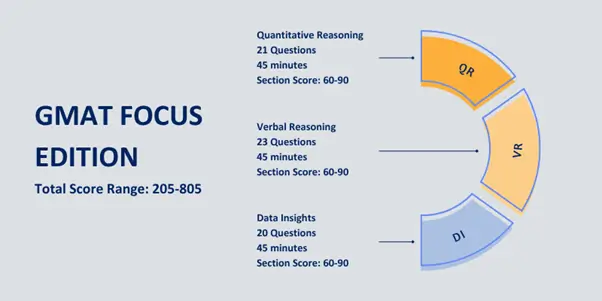
Understanding the GMAT Focus Edition
The GMAT Focus Edition is designed to test the skills that matter most in business school: critical thinking, data analysis, and decision-making under pressure. It includes three equally weighted 45-minute sections:
- Quantitative Reasoning (21 questions)
Tests how well you reason through numbers, solve algebraic and arithmetic problems, and make logical decisions. There’s no geometry and no calculator, so efficiency and accuracy are key.
- Verbal Reasoning (23 questions)
Focuses entirely on reading comprehension and critical reasoning. Sentence correction is gone; instead, you’ll need to analyze arguments, spot assumptions, and separate fact from opinion.
- Data Insights (20 questions)
Exclusive to the Focus Edition, this section measures your ability to interpret data from tables, charts, and multiple sources. You’ll face integrated reasoning problems that reflect how real managers make data-driven decisions.
This redesigned format eliminates older, less relevant content and gives equal weight to each section, with a total score range of 205 to 805.
That means you can’t afford to neglect any part of the test, especially Data Insights.
Setting Expectations for a Condensed Timeline
To make real progress in just eight weeks, you’ll need discipline, structure, and precision.
Expect to study nearly every day, carving out focused study blocks in the early mornings, evenings, or weekends.
If you’re working full-time, plan for extra practice time during the final weeks; even a short study break from work can make a measurable difference.
In a short timeline, success depends on prioritizing high-yield topics and efficient strategies. Forget about covering every obscure question type.
To get started, use official GMAT practice tests to establish your baseline and track your improvement.
But the real advantage comes from using an adaptive learning platform like Gurutor. Instead of wasting hours on questions you already know, Gurutor continuously analyzes your performance, pinpoints your weak areas, and delivers targeted practice that accelerates improvement.
That’s how top scorers make every minute count, by studying smarter, not just harder.
Your 2‑Month GMAT Prep Plan: A Week‑by‑Week Breakdown
The following eight‑week schedule is designed for ambitious candidates who can commit at least 12–15 hours per week. It blends best practices from official sources, test‑prep experts, and Gurutor’s adaptive learning philosophy.
Adjust the pace according to your diagnostic score and personal commitments, but maintain the overall structure: build foundations first, then practice under timed conditions, review, and fine‑tune.
Here’s your 2-month GMAT study schedule, divided into weeks:
Weeks 1–2: Diagnostic Baseline and Core Concepts
Here’s a detailed plan for Weeks 1 to 2:
| Focus Area | What to Do | Why It Matters |
| Take a Diagnostic Test | Begin with the free GMAT Official Practice Exam 1 to establish your baseline score. Analyse results to identify strengths, weaknesses, and timing patterns. | Knowing your starting point lets you build a focused, efficient study plan. |
| Review Quantitative Basics | Refresh arithmetic (fractions, ratios, percentages), algebra (equations, exponents, quadratics), and basic statistics (mean, median, mode, standard deviation). Focus on number properties and word problems. | These core topics appear frequently on the GMAT Focus Edition and drive your Quant score. |
| Build Verbal Foundations | Study critical reasoning and reading comprehension strategies. Practise identifying arguments, assumptions, and logical flaws. Read dense non-fiction and summarise key points. | The Focus Edition tests reasoning and comprehension, not grammar, so it strengthens analytical reading. |
| Explore Data Insights | Learn the four question formats: graphics interpretation, table analysis, multi-source reasoning, and two-part analysis. Practise interpreting charts and combining information. | Data Insights carries equal weight, and mastering it early prevents last-minute stress. |
| Organise Study Materials | Use the GMAT Official Guide and adaptive tools like Gurutor for targeted practice. Skip outdated topics (sentence correction, geometry, AWA). | Focus only on relevant content; efficiency is key in a two-month plan. |
| Prioritise Well-Being | Sleep 7–8 hours, take short breaks, and maintain healthy meals and light exercise. Avoid burnout by pacing your study sessions. | A rested mind retains concepts better and performs more consistently on test day. |
Weeks 3–4: Practice Drills and Adaptive Learning
By Weeks 3–4, your foundation should be set; now it’s time to turn practice into performance. This phase is all about adaptive learning, timed drills, and strategic refinement.
Here’s how to structure your next two weeks effectively:
| Focus Area | What to Do | Why It Matters |
| Build Targeted Practice Sets | Create mixed, timed question sets covering Quant, Verbal, and Data Insights. Keep an error log that tracks every mistake, the concept involved, and the correct approach. | Reviewing mistakes systematically turns weaknesses into strengths and accelerates improvement. |
| Use Adaptive Tools | Replace static question banks with adaptive platforms like Gurutor. | Adaptive learning ensures you focus only on high-impact topics, not repetitive drills. |
| Practise Under Timed Conditions | Time every study session and simulate test-day pacing. Aim for consistent speed and accuracy, and spend enough time on early questions. Avoid exceeding three minutes per problem. | Builds test endurance, time awareness, and confidence under pressure. |
| Strengthen Data Insights Skills | Drill on question types such as graphics interpretation, table analysis, and multi-source reasoning. Practise using the on-screen calculator and the three-edit review rule. | Data Insights is new and heavily weighted; mastering it early gives you a competitive edge. |
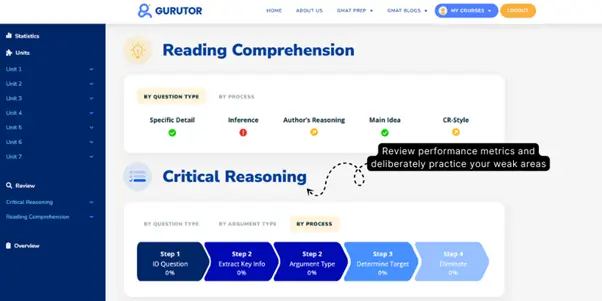
| Track and Adjust with Feedback | Use Gurutor’s analytics to monitor accuracy, timing, and topic mastery. When error patterns emerge, dedicate focused review sessions to those areas. | Real-time feedback ensures you’re always improving efficiently, not repeating past mistakes. |
Weeks 5–6: Full‑Length Mock Tests and In‑Depth Review
By Weeks 5–6, your preparation should shift from learning concepts to simulating the real exam experience.
This stage is about building endurance, mastering timing, and refining your test-day strategy through deep review and data-driven focus.
For efficient GMAT preparation during these weeks, consider the following:
| Focus Area | What to Do | Why It Matters |
| 1Take Weekly Full-Length Tests | Schedule one full-length GMAT Focus Edition mock test each week. Simulate real conditions, use the official tools, take only allowed breaks, and avoid pausing. | Builds mental stamina, focus, and familiarity with the test interface and timing. |
| Review Every Test in Detail | Spend 2–3 hours reviewing each practice test. Identify whether errors came from weak concepts, misreads, or poor pacing. Update your error log and revisit problem areas. | Deep review converts every mistake into a learning opportunity and sharpens test-day precision. |
| Monitor Time Management Patterns | Analyse pacing across sections. Set time goals per question, 1-2 minutes. Practise finishing Data Insights sections on time. | Effective pacing prevents score drops from rushed guesses or unanswered questions. |
| Prioritise High-Yield Topics | Focus your remaining study time on arithmetic, algebra, word problems, statistics, and Data Insights. Skip outdated or removed topics like geometry and grammar. | Concentrating on high-impact areas maximises score gains in a short window. |
| Practise Test-Day Decision-Making | Train yourself to make smart, fast decisions under pressure. Practise strategic guessing when stuck, don’t chase perfection on every question. | The GMAT Focus Edition rewards consistent reasoning and time management, not perfectionism. |
Weeks 7–8: Final Review and Advanced Practice Tests
By Weeks 7–8, your focus shifts from learning to refining, simulating, and stabilizing performance.
This final stretch is about confidence, precision, and mindset, ensuring you perform your best when it counts most.
| Focus Area | What to Do | Why It Matters |
| Take Final Full-Length Mock Exams | In Week 7, take one full-length mock under strict conditions. In Week 8, schedule two more practice exams to test endurance and pacing. Use official GMAT reports to analyze section-by-section performance. | Builds test-day rhythm and confirms readiness across all three sections. |
| Target Weak Areas with Data | Use Gurutor’s analytics and official score breakdowns to identify last-minute weaknesses. Focus extra practice on low-performing question types or sections. | Precision review delivers faster score improvement than a broad study in the final phase. |
| Simulate the Real Exam Environment | Take practice tests at the same time of day as your scheduled GMAT. Use the digital whiteboard and on-screen calculator exactly as on test day. | Familiarity reduces anxiety and helps you perform consistently under real conditions. |
| Refine Strategy and Timing | Practise the “three-edit rule” (review and adjust up to three answers per section) and maintain your ideal pacing plan. | Reinforces efficient test navigation and minimizes costly time errors. |
| Rest, Review, and Recharge | In the final week, avoid learning new topics. Review your error log, refresh key strategies, and prioritise rest and positive focus. | A clear, rested mind performs better than an overworked one; mental freshness boosts accuracy. |
The Importance of Real‑Time Feedback in a 2‑Month GMAT Plan
Traditional prep materials, static tests, question banks, and books provide only limited feedback. They often present a single solution to each question, leaving students to wonder whether a faster or more intuitive method exists.
And many students focus on memorizing rules and solutions without understanding how to approach problems flexibly, which leaves them struggling when faced with unfamiliar question formats.
Modern adaptive learning systems, such as Gurutor’s platform, solve these problems by providing real‑time feedback.

After each question or drill, the platform analyses your response, identifies the reasoning path you used, and suggests a tailored strategy. If you misread a critical reasoning prompt, the tool immediately highlights the relevant argument structure and points you to lessons.
For example, if you consistently waste time on Data Insights questions, the system flags your time per question and prompts timed drills to improve speed.
You learn to start strong (because early questions matter more), monitor your pacing, and adjust your strategy mid‑test.
This targeted approach is particularly valuable when you have only two months, ensuring that every study hour yields the maximum score improvement.
Maximising Study Time: How Gurutor’s Adaptive Learning Makes a Difference in 2-Months
For the GMAT 2-month study plan, Gurutor ensures your study time is strategic, targeted, and results-driven.
1. Structured Study Path
Weak areas get more focus while strengths are maintained, and you constantly update as you improve. This ensures that every session targets the next-largest opportunity for score gains.
2. Efficient Content Curation
All content aligns with the GMAT Focus Edition. Outdated topics like sentence correction, geometry, and AWA are skipped, while drills focus on arithmetic, algebra, word problems, reading comprehension, logical reasoning, and Data Insights.

3. Intelligent Scheduling and Goal Tracking
Gurutor factors in your availability and energy levels, setting realistic daily goals and balancing study intensity. Scheduled breaks and longer weekend sessions prevent burnout while maximising productivity.

4. Adaptive Drills with Expert Insights
Incorrect answers trigger analysis of top-scorer approaches, showing multiple solution paths. This develops mental agility and helps you find the fastest, most reliable strategies under timed conditions.
Gurutor ensures every minute counts, turning targeted practice into measurable GMAT improvement.
Key GMAT Strategies for Acing the Exam in 2 Months
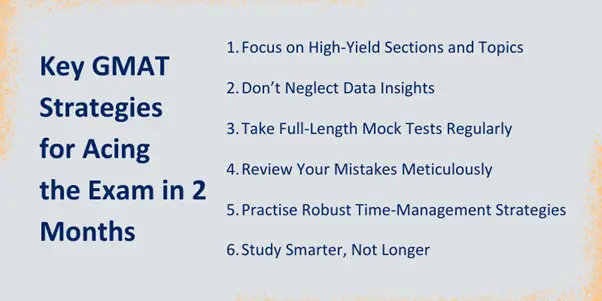
To make the most of a condensed study timeline, focus on high-impact techniques and smart strategies that maximise score gains in every session.
1. Focus on High‑Yield Sections and Topics
The GMAT Focus Edition rewards mastery of core concepts rather than memorisation of obscure rules. Concentrate on the topics tested most frequently:
- Arithmetic & Algebra: Refresh calculations, ratios, percentages, exponents, and equations. These fundamentals form the backbone of most problem-solving questions.
- Statistics & Probability: Understand mean, median, mode, range, and basic probability. Practise combinatorics to handle common GMAT scenarios.
- Word Problems: Master types like Venn diagrams, work/rate, distance/rate, mixtures, weighted averages, and unit conversions.
- Critical Reasoning & Reading Comprehension: Focus on identifying conclusions, premises, and assumptions. Practise summarising dense passages and drawing logical inferences efficiently.
- Data Insights: Drill graphics interpretation, table analysis, multi-source reasoning, and two-part analysis. Use the calculator strategically; many questions rely more on logical reasoning than computation.
Concentrating on these high-yield areas ensures your study time has the greatest impact on your GMAT score.
2. Don’t Neglect Data Insights
Many candidates focus on Quant and Verbal while ignoring the newest section. This strategy backfires because Data Insights counts for one‑third of your total score.
In addition, the question formats are unfamiliar, and the on‑screen calculator can lure you into time‑consuming computations. Instead, prioritise Data Insights early.
3. Take Full‑Length Mock Tests Regularly
Full-length practice tests are essential for building stamina, refining pacing, and identifying weaknesses. Schedule tests consistently throughout your two-month plan and dedicate time to thoroughly reviewing each one.
Use official GMAT practice exams when possible, as they mirror the real scoring algorithm and provide detailed performance insights.
Simulate the GMAT test-day conditions: take the exam at the same time of day as your scheduled test, follow the allowed breaks, and practise using the scratch booklet or online whiteboard.
This prepares you mentally and physically, ensuring you can sustain focus and perform consistently across all sections.
4. Review Your Mistakes Meticulously
Learning from mistakes is the fastest way to improve. Write down the question type, the concept tested, what you thought the answer was, why you chose it, why it was wrong, and the correct approach.
Review this log regularly and prioritise concepts that appear repeatedly. When you review full‑length tests, spend three hours or more analysing each error.
Also, resist the temptation to rework the problem until you get it right simply; instead, focus on the thought process and timing that led to the mistake.
5. Practise Robust Time‑Management Strategies
Time management is arguably the single most important test‑taking skill on the GMAT. Here are several actionable strategies:
- Prioritise the Beginning of Each Section: Early questions carry more weight in a computer-adaptive test. Take enough time to avoid careless mistakes, but don’t get stuck.
- Set Realistic Per-Question Limits: Aim to spend no more than three minutes on a single question. If you can’t solve it within that time, make an educated guess and move on. Practise completing easier questions faster to build a buffer for tougher ones.
- Use Timers Effectively: Start without a timer to focus on accuracy, then practise timed sessions to improve speed. During full-length mocks, monitor the on-screen timer to maintain pacing.
- Avoid Perfectionism: Striving for 100% accuracy can jeopardise your overall performance. Focus on consistent progress and strategically move past questions that threaten your pacing.
These habits help you stay disciplined under pressure, ensuring every minute counts on test day.
6. Study Smarter, Not Longer
Use micro‑sessions and targeted practice rather than endless problem sets. You can study for three 30‑minute sessions each day, interspersed with breaks, and using mobile apps for micro‑sessions to make use of idle time.
Or you can create a tailored schedule based on your availability and energy levels, avoiding continuous multi‑hour sessions that can lead to burnout.
How to Stay Motivated and Avoid Burnout During Intense Preparation
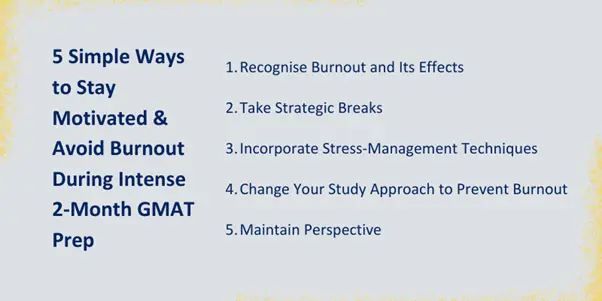
Intensive preparation over a short period can strain even the most disciplined candidates. Understanding the physiology of stress and burnout helps you manage it effectively.
1. Recognise Burnout and Its Effects
Burnout is a state of chronic stress that reduces focus, memory retention, and overall learning efficiency. Signs include exhaustion, frustration, and lack of concentration. Ignoring them only makes study hours less effective.
2. Take Strategic Breaks
Powering through isn’t the solution. Schedule at least a couple of full rest days, ideally around the midpoint of your program (weeks 4–5).
Temporary breaks allow your brain to consolidate knowledge and return refreshed for the intensive mock-test phase.
3. Incorporate Stress-Management Techniques
Prep isn’t just about questions; your psychological readiness matters. Practices like mindfulness, meditation, exercise, or even short walks can reduce stress.
Prioritise sleep, especially REM sleep, as it is crucial for long-term memory consolidation.
4. Change Your Study Approach to Prevent Burnout
After a break, vary your study routine: switch topics, adjust session length (max 90 minutes), change locations, or alternate between Quant, Verbal, and Data Insights.
Variety keeps motivation high and trains your brain to handle the exam’s sequence.
5. Maintain Perspective
Remember, the GMAT is only one component of your application. If prep starts harming health or other commitments, it’s acceptable to pause or adjust.
A strong overall application, work experience, essays, recommendations, and interviews can offset a slightly lower score.
This balanced approach ensures you stay motivated, prevent burnout, and maximise your performance in a short prep window.
Final Week: Reviewing and Fine‑Tuning Your Strategy
The last week of your two‑month prep plan is about refinement, not learning new content.
You’ve built a solid foundation, practised under timed conditions, taken multiple mock tests, and identified your weak spots.
Now concentrate on finishing strong.
Conduct Two or More Final Mock Tests
Schedule two full‑length practice tests during your final week. Take one at the beginning of the week and the second three or four days later.
Use the first test to check pacing and mental stamina; treat it as a dress rehearsal for test day. After reviewing your mistakes, focus on patching any remaining knowledge gaps.
The second test acts as your final simulation; replicate everything you’ll do on the actual exam, from your wake‑up time to your break snacks.
Review Detailed Score Reports
GMAC’s official score reports and practice‑exam reports provide detailed performance insights. They show section scores, percentile rankings, and time spent per question.
Use these analytics to refine your strategy. If your timing on Data Insights is still slow, practise solving easier data questions quickly to build a buffer.
If your Quant score is solid but Verbal lags, concentrate on inference‑based reading and argument evaluation.
Simulate Test Day Conditions
By now, you should have a ritual: the same time of day, the same pre‑test meal, the same scratch‑board setup. Don’t neglect logistics.
Make sure you meet ID and technical requirements (quiet space, stable internet, valid photo ID). Also, plan your route to the test centre or prepare your home testing space ahead of time.
Rest and Maintain Confidence
In the final days, lighten your study load. Review your error log, revisit key formulas and reasoning strategies, and do a few short drills to stay sharp.
Avoid learning new material; Kaplan warns against studying new topics the day before an exam. Instead, prioritise sleep and relaxation. Use stress‑management techniques and visualise success.
On test day, remind yourself that you’re well prepared and that you’ve practised under the same conditions. Walk into the exam with confidence and calm.
Conclusion: Achieve Your GMAT Goal in 2 Months with Gurutor
Acing the GMAT in just two months is ambitious, but with a focused plan, adaptive tools, and a healthy mindset, it’s entirely possible.
The GMAT Focus Edition emphasises critical thinking, data analysis, and logical reasoning, and each section carries equal weight, so no area is neglected.
A two-month study plan demands efficiency and strategy: start with a diagnostic test, build a strong foundation in core topics, practise under timed conditions, and use full-length mock tests to refine pacing.
For this, maintain an error log and actively learn from mistakes. Master time-management strategies, making educated guesses when necessary, and prioritise high-yield topics to maximise score gains.
Importantly, investing in adaptive learning like Gurutor gives you personalised feedback, dynamic study paths, and targeted practice that static prep materials cannot match.
Finally, safeguard your well-being. Adequate sleep, regular exercise, stress-management techniques, and strategic breaks help maintain focus, memory, and performance.
With this structured, adaptive, and holistic approach, you’ll be fully prepared for the GMAT and develop study habits that extend beyond the exam.
Ready to Max Your GMAT Score in 2 Months?
Take control of your prep with Gurutor’s adaptive, personalised platform. Every session is designed to maximise score gains so you can achieve your GMAT goal efficiently.
Start today and turn two months into your best GMAT performance yet.